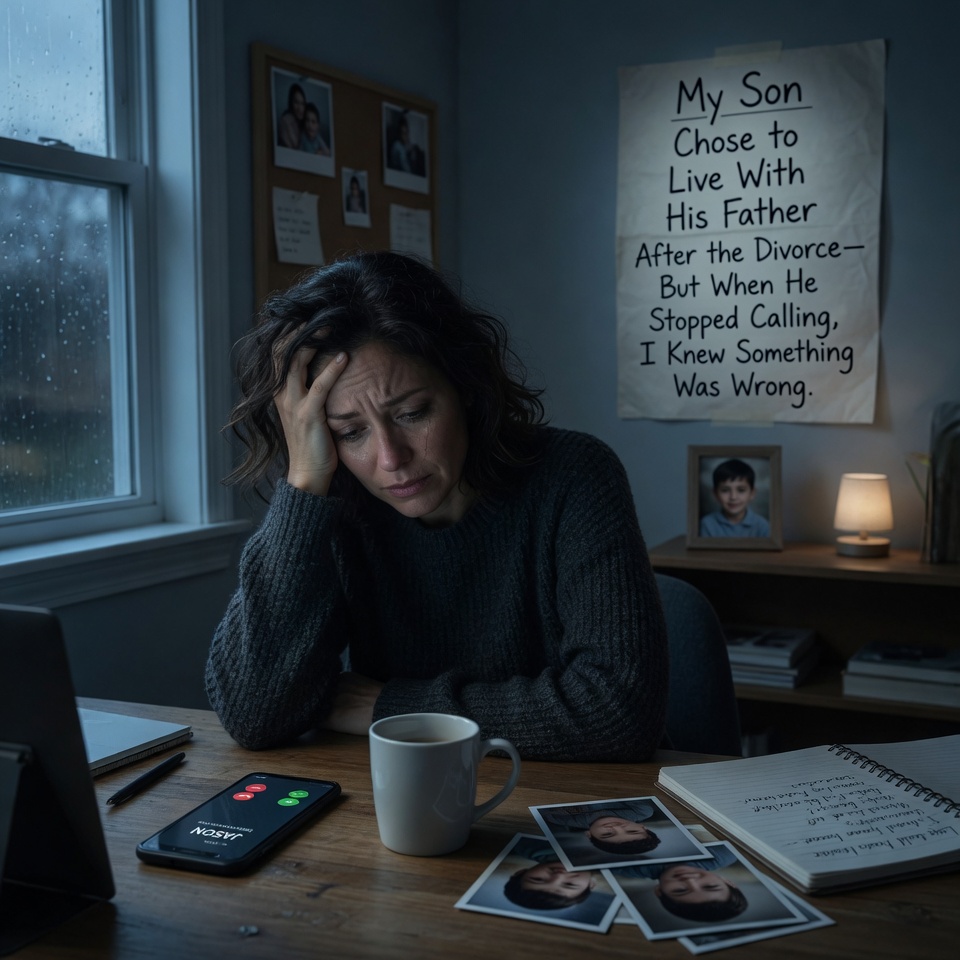
When my 14-year-old son, Ethan, asked if he could move in with his father after our divorce, I said yes.
Not because it was easy.
Not because I wanted to.
And certainly not because my heart wasn’t breaking.
I said yes because I loved him more than I loved my own comfort.
His father, Ryan, and I had been divorced for almost three years. The arrangement had worked reasonably well. Ethan spent weekdays with me and every other weekend with his dad.
But as he got older, he began craving more time with him.
Ryan had recently moved into a larger house in a neighboring town. There was a basketball court nearby. Better sports programs. More teenagers his age.
Most importantly, Ethan missed his dad.
I could see it.
So when he sat across from me one evening and nervously said, “Mom, what would you think if I stayed with Dad for a while?” I smiled.
Even though I felt my chest tighten.
“If that’s what you want, we’ll figure it out.”
The relief on his face was immediate.
And that alone convinced me I’d made the right decision.
The first few months were exactly what I hoped they would be.
He called constantly.
Photos flooded my phone.
Pictures of fishing trips.
Late-night pizza experiments.
Basketball games.
Movie marathons.
There was even a video of Ryan attempting to assemble a bookshelf and accidentally trapping himself inside it.
I laughed so hard I cried.
For the first time in a long time, Ethan seemed genuinely happy.
And despite missing him terribly, I felt grateful.
Maybe this was exactly what he needed.
Maybe this was exactly what they both needed.
But then something changed.
At first, it was subtle.
The daily texts became every few days.
The phone calls grew shorter.
Instead of telling me stories, Ethan answered questions.
“School good?”
“Yep.”
“How’s soccer?”
“Fine.”
“What did you do this weekend?”
“Nothing much.”
The conversations felt strange.
Like someone had slowly turned down the volume on his personality.
Still, I told myself not to panic.
Teenagers pull away.
That’s what they do.
But then his English teacher emailed me.
“Mrs. Carter, I wanted to reach out because Ethan hasn’t submitted his last two assignments. This is unusual for him.”
I stared at the screen.
Ethan was many things.
Forgetful wasn’t one of them.
A week later, his science teacher called.
Then the guidance counselor.
Every conversation sounded similar.
“He seems distracted.”
“He looks exhausted.”
“He’s not participating.”
“He doesn’t seem like himself.”
That last sentence echoed in my head.
Doesn’t seem like himself.
I knew exactly what they meant.
Because I hadn’t heard my son’s real laugh in weeks.
I called Ryan that night.
“Have you noticed Ethan seems different?”
There was a pause.
Then a sigh.
“Claire, you’re overreacting.”
My stomach sank.
“I’ve had three teachers contact me.”
“He’s a teenager.”
“He never used to miss assignments.”
“Maybe he’s growing up.”
The conversation ended shortly afterward.
But I couldn’t shake the feeling that something was wrong.
Every instinct I had was screaming.
And for the first time since Ethan moved out, I stopped worrying about whether I was being too involved.
I started worrying that I wasn’t involved enough.
A few days later, I drove to his school.
I didn’t tell Ryan.
I didn’t call ahead.
I just went.
The final bell rang.
Students poured out into the parking lot laughing and talking.
Then I spotted Ethan.
And my heart shattered.
He wasn’t walking.
He was dragging himself forward.
His backpack hung from one shoulder.
His hoodie looked too big.
His face looked pale.
But it was his eyes that stopped me cold.
They looked tired.
Not normal teenager tired.
Not stayed-up-too-late tired.
Exhausted.
The kind of exhaustion that reaches deeper than sleep.
I rolled down my window.
“Ethan.”
He looked up.
The second he saw me, something in his expression changed.
Not excitement.
Relief.
Pure relief.
He climbed into the car without saying a word.
I drove us to a nearby café.
For almost twenty minutes, neither of us spoke.
Finally, I slid a hot chocolate across the table.
His favorite.
He wrapped both hands around it.
Then stared into the cup.
And whispered:
“I don’t know what to do anymore.”
The words barely reached me.
But they hit like a freight train.
“What do you mean?”
His eyes filled with tears.
And slowly, piece by piece, the truth emerged.
About two months after Ethan moved in, Ryan lost his job.
He hadn’t told anyone.
Not me.
Not family.
Not even Ethan at first.
He kept pretending everything was fine.
But the financial pressure quickly became overwhelming.
Bills started piling up.
Savings disappeared.
Stress invaded every corner of the house.
Ryan stopped sleeping.
Stopped laughing.
Stopped being present.
And without realizing it, he leaned on Ethan.
At first, it was small things.
Watching his eight-year-old stepbrother after school.
Helping with groceries.
Cooking dinner occasionally.
Nothing unusual.
But gradually, those responsibilities multiplied.
Soon Ethan was making dinner most nights.
Helping with homework.
Cleaning.
Managing household chores.
Trying to keep everyone calm whenever tension exploded.
“I thought I was helping,” he said quietly.
“You were helping.”
He shook his head.
“No, Mom. I became the adult.”
Tears slid down his face.
“I didn’t know how to stop.”
My chest felt like it might cave in.
He told me about nights spent awake worrying about money.
About overhearing arguments through thin walls.
About pretending everything was okay at school.
About feeling guilty whenever he wanted to spend time with friends because he knew someone needed him at home.
Most heartbreaking of all…
He thought protecting his father was his responsibility.
“I didn’t want anyone thinking he was failing.”
I reached across the table and grabbed his hand.
“Oh, sweetheart.”
That’s when he completely broke down.
Not loudly.
Not dramatically.
Just years of strength collapsing all at once.
And I realized how lonely he’d been.
How scared.
How overwhelmed.
And how desperately he’d needed someone to notice.
That night, I brought him home.
Not permanently.
Just for the weekend.
At least that was the excuse I gave myself.
The reality was different.
The second he walked into his old bedroom, I knew he wasn’t ready to go back.
Everything was exactly where he’d left it.
The same posters.
The same shelves.
The same old baseball glove sitting on his desk.
He stood in the doorway silently.
Then sat on the bed.
And cried.
I sat beside him.
Neither of us said anything.
We didn’t need to.
Sometimes love looks like words.
Sometimes it looks like simply staying.
That night he slept nearly fifteen hours.
When I checked on him the next morning, he hadn’t moved.
The dark circles under his eyes seemed lighter.
His breathing was peaceful.
For the first time in months, he looked like a child.
Not someone carrying the weight of an entire household.
Just my son.
When he finally woke up, he wandered into the kitchen.
His hair stuck up in every direction.
“Morning.”
“Good afternoon,” I laughed.
He smiled weakly.
“What smells so good?”
“Bacon.”
His eyes widened.
“Seriously?”
“And pancakes.”
“I love you.”
That was the first joke he’d made in months.
And hearing it nearly made me cry.
The weeks that followed weren’t easy.
Healing rarely is.
At first, Ethan barely talked.
He came home from school.
Dropped his backpack.
Collapsed onto the couch.
Sometimes he stared at the television without watching it.
Sometimes he sat quietly in his room.
I didn’t pressure him.
I didn’t interrogate him.
I simply created peace.
Consistent meals.
Predictable routines.
A calm home.
Little by little, he began opening up.
We started taking evening walks.
Sometimes we’d talk.
Sometimes we’d just walk.
Both helped.
A therapist became part of his support system.
Not because he was broken.
Because everyone deserves help carrying heavy things.
Especially children.
One afternoon, I found a sticky note attached to the refrigerator.
In Ethan’s handwriting.
“Thanks for making dinner.”
It sounds small.
But it wasn’t.
Because gratitude meant he was noticing things again.
Hope meant he was feeling things again.
Life meant he was returning.
A month later, he asked if he could rejoin robotics club.
My heart nearly burst.
Ethan had always loved building things.
As a child, he spent hours constructing impossible towers from blocks.
Now he wanted to create again.
Dream again.
Imagine again.
The first robot his team built failed spectacularly.
Its wheels fell off during a competition.
The entire audience laughed.
Including Ethan.
Especially Ethan.
And hearing that laugh felt like sunlight after a long winter.
Eventually, Ryan and I sat down together.
Not as former spouses.
As parents.
The conversation was difficult.
Painful.
Honest.
Ryan admitted he’d been drowning.
He admitted he should have asked for help.
And perhaps hardest of all…
He admitted he hadn’t realized how much Ethan was carrying.
There were tears.
Apologies.
Promises.
No villains.
Just flawed people trying to do better.
Today, Ethan lives with me full-time.
But he still sees his dad regularly.
Their relationship continues to heal.
Slowly.
Patiently.
One conversation at a time.
Last spring, Ethan received an award at school.
“Student Leadership and Resilience.”
As he walked across the stage, my eyes filled with tears.
Not because he won an award.
Because I remembered the boy who sat across from me months earlier whispering:
“I don’t know what to do anymore.”
And now here he was.
Standing tall.
Smiling.
Thriving.
When his name was called, he looked into the audience.
First at me.
Then at his dad.
And smiled at both of us.
That single moment contained more healing than words could describe.
Today, his room is messy again.
There are sports bags everywhere.
Half-finished projects covering every available surface.
Snack wrappers mysteriously appearing in places they shouldn’t.
Music playing too loudly.
Friends constantly visiting.
Normal teenage chaos.
And I’ve never loved chaos more.
Sometimes I catch him writing notes to himself on index cards above his desk.
“Keep going.”
“You’ve got this.”
“One day at a time.”
Whenever I see them, I smile.
Because they remind me how far he’s come.
And they remind me of something else too.
Children don’t always tell us when they’re struggling.
Sometimes they hide it because they’re afraid.
Sometimes because they’re loyal.
Sometimes because they think they’re protecting the people they love.
But silence is not always peace.
And independence is not always strength.
Sometimes the bravest thing a child can do is hope someone notices.
And sometimes the most important thing a parent can do is show up anyway.
Even when they say they’re fine.
Even when they push you away.
Even when you’re afraid of being wrong.
Because love isn’t just letting go.
Sometimes love is holding on.
And sometimes it means reaching out your hand when someone is quietly slipping beneath the surface.
I will never regret reaching for my son.
Not for a second.
Because every parent gets moments that change everything.
For me, it was the moment I looked into Ethan’s tired eyes in that school parking lot and realized he wasn’t asking for space.
He was asking to be seen.
And once I saw him, I wasn’t going to look away.